Object Oriented Programming Basics
As mentioned earlier, object-oriented is a term, which is interpreted differently by different people. It is therefore necessary to understand some of the concepts used extensively in object-oriented programming. We shall now discuss the general concepts of OOP which form the heart I if .lava language.
Objects and Classes
Objects are the basic runtime entities in an object-oriented system. They may represent a person, a place, a bank account, a table of data or any item that the program may handle. They may also represent user-defined data types such as vectors and lists. Any programming problem is analyzed in terms of objects and the nature of communication between them. Program objects should be chosen such that they match closely with the real-world objects. As pointed out earlier, an object takes up space in the memory and has an associated address like a record in Pascal, or a structure in C.
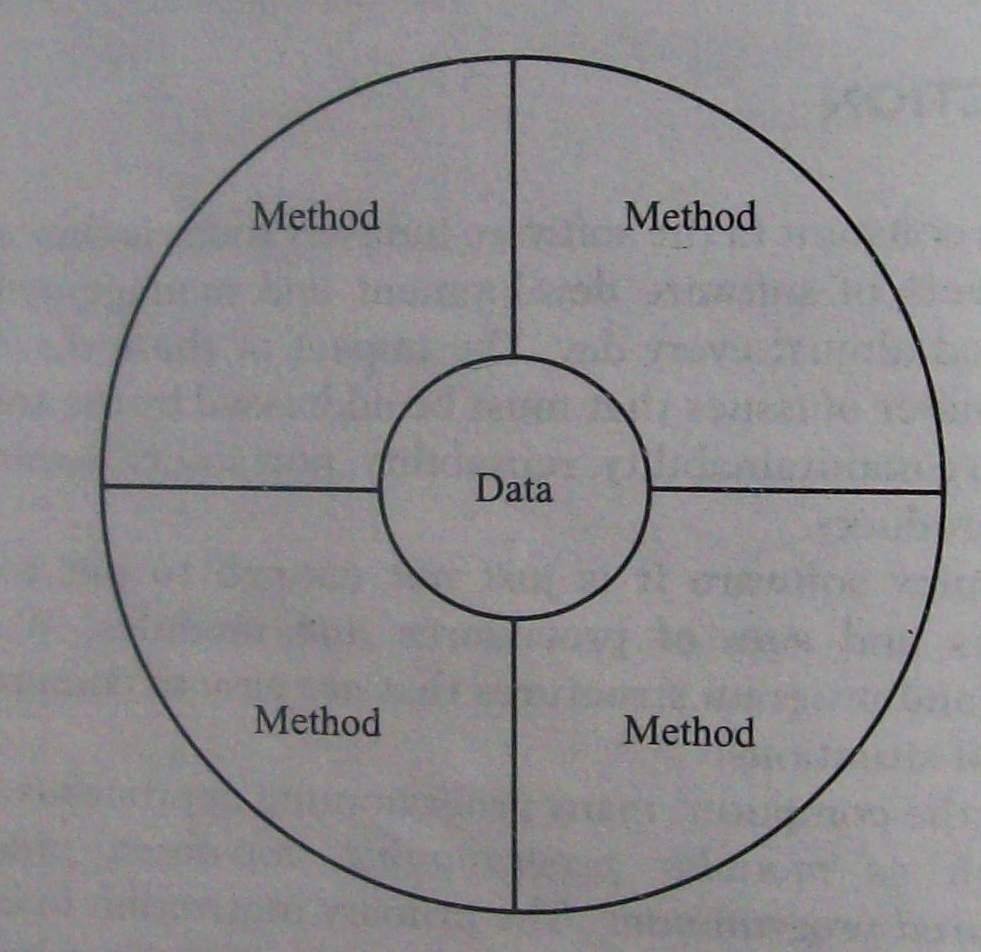
When a program is executed, the objects interact by sending messages to one another. For example, 'customer' and 'account are two objects in a banking program, then the customer object may send a message to the account object requesting for the balance. Each object contains data and code to manipulate the data. Objects can interact without having to know the details of each other's data or code. It is sufficient to know the type of message accepted and the type of response returned by the objects. Although different authors represent them differently, Fig. 1.2 shows ti notation that is Popularly used to represent an object in object oriented analysis and design.
We just mentioned that objects contain data and code to manipulate that data. The entire set of data and code of an object can be made a user-defined data type using the concept of a class. A c!ass may be thought of as a 'data type' and an object as a 'variable' of that data type. Once a class has been defined, we can create any number of objects belonging to that class. Each object is associated Wit lit he data of type class with which they are created. A class is thus a collection of objects of similar type. For example, mango, apple and orange are members of the class fruit.

Classes are user-defined data types and behave like the built-in types of a programming language. For example, the syntax used to create an object is no different than the syntax used to create an integer object in C. If fruit has been defined as a class, then the statement
Fruit mango •
will create an object mango belonging to the class fruit